How to choose where to publish: verifiable signals of a serious journal
There is no reliable blacklist and no complete whitelist. What does exist is a set of signals you can check yourself in twenty minutes.
The real problem
Every week emails arrive offering to publish your work in record time, inviting you onto the editorial board of a journal you have never heard of, or asking you to guest-edit a special issue. Some of those invitations are legitimate. Many are not, and publishing in the wrong place is hard to undo: the article stays there, and withdrawing it to publish elsewhere is usually not an option.
The lists of "predatory" journals that circulate are incomplete, sometimes unfair and always out of date. It is more useful to learn to read the signals.
Signals you can check in twenty minutes
1. The editorial board exists and knows it
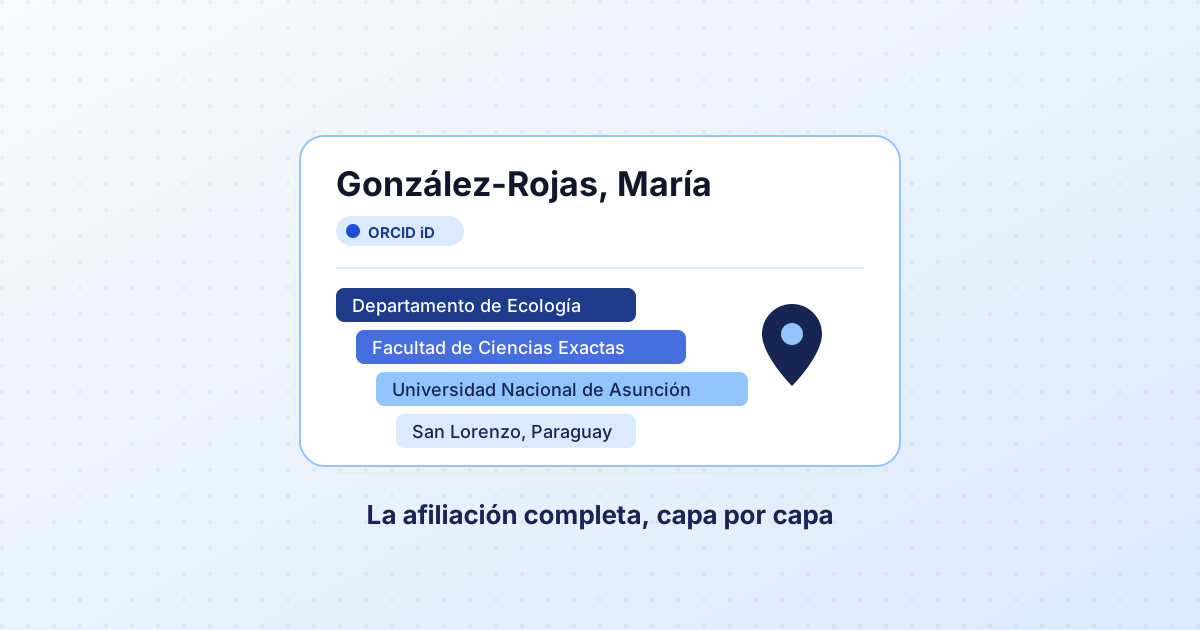
Take three names from the editorial board and look them up. Do they exist? Do they work at the institution the journal claims? Do they mention the journal on their institutional page or CV? A board full of prestigious names who mention the journal nowhere is the most reliable warning sign there is.
2. The editorial process is described and plausible
The journal should explain what kind of review it applies (single-blind, double-blind, open), who decides and on what timeline. "Review in 48 hours" is not efficiency: it is a confession that there is no review.
3. Charges are published before submission
Charging to publish is not a bad signal in itself: many open access journals funded by processing charges are excellent, and a great many Latin American journals charge nothing at all. The bad signal is a fee that only appears after acceptance, or that changes depending on who asks.
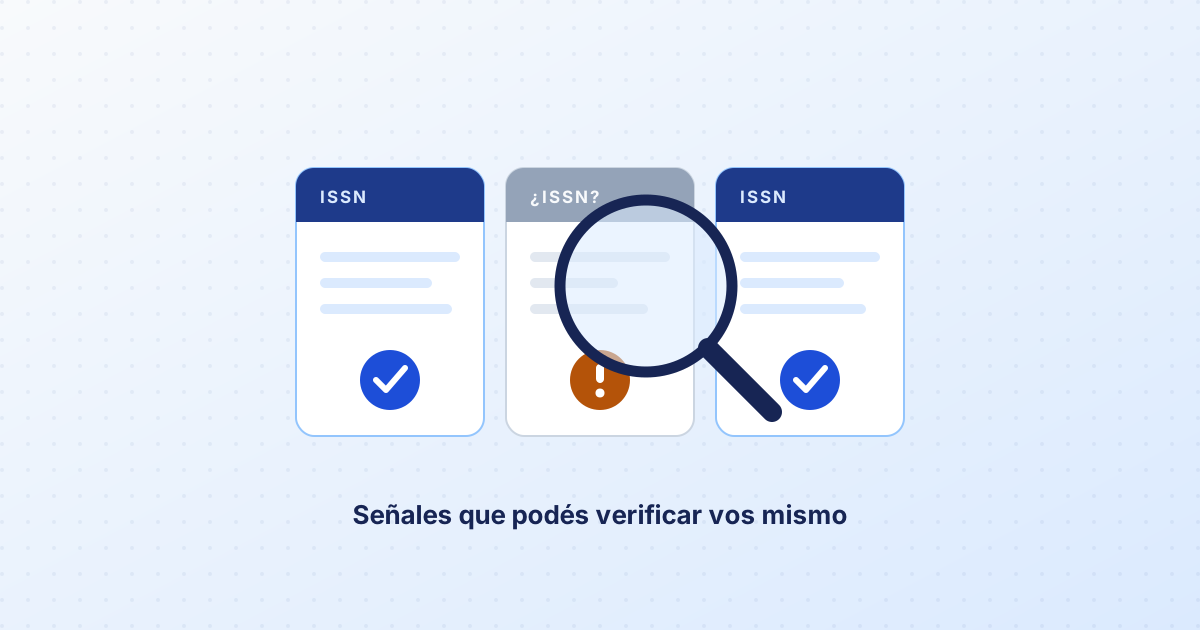
4. The ISSN is real and belongs to that journal
An ISSN can be checked at the ISSN International Centre portal. A journal displaying a number means nothing; that number matching that title means something.
5. The published articles hold up
Open three articles from the latest issue. Are they properly edited? Do they have a DOI, and does the link work? Are the authors from real and varied institutions, or all from the same place? Is the language cared for? A serious journal does not publish a whole issue of authors from a single institution without explanation.
6. The publication schedule is met
A journal that claims to be quarterly and whose latest issue is two years old has a problem, even if it is not dishonest. Publishing there means risking that your article ends up in limbo.
7. It can be found outside its own website
Search for the title of one of its articles in an academic search engine and in regional aggregators. If the content only exists on the journal’s own site, its visibility is close to zero and its permanence depends on someone continuing to pay for hosting.
8. There is a preservation policy
Ask yourself what happens to your article if the journal shuts down. Journals that take this seriously take part in digital preservation networks and say so openly.
Direct red flags
- Unsolicited emails with generic praise for a paper you published years ago.
- Invented metrics with names resembling real impact factors.
- An impossible scope: a journal publishing medicine, engineering and literature.
- A contact address that does not exist, or a free mailbox as the only contact.
- Promises of indexing in databases where the journal does not appear.
A simple method
Before submitting, write down the answers to these questions: who runs the journal, what review it applies, what it costs, what its ISSN is, where its content can be found and what happens if it closes. If you cannot answer three of the six with verifiable data from the journal’s own site, look for another journal. Asking your institution’s library before submitting usually saves months.