How to sign your papers: a consistent name and a complete affiliation
Your byline and affiliation are metadata, not paperwork. How you write them decides whether your output can be counted, and whether your institution shows up in the rankings that measure it.
A byline is structured data disguised as text
When you type your name into a submission form you are not filling in a decorative field: you are creating the key that hundreds of systems will use to group — or split — your work. Aggregators, academic search engines and directories work with that string exactly as you wrote it.
Practical rules for your name
- Pick one form and never change it. If you are going to use two surnames, always use both. If you are going to use a middle initial, always include it.
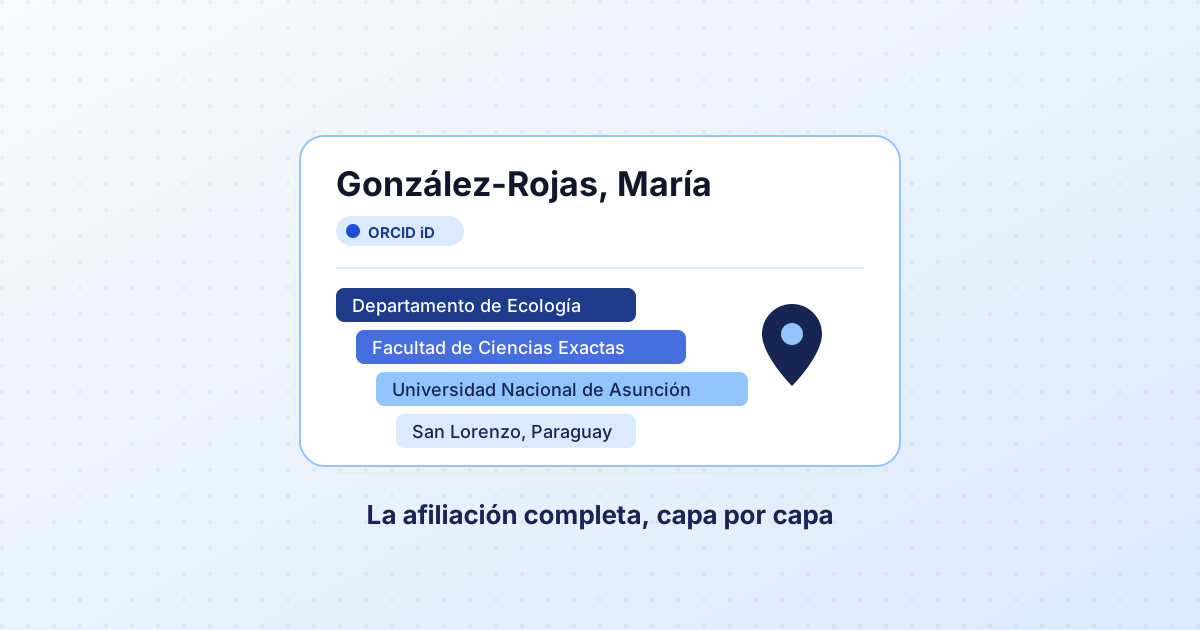
- Hyphenate compound surnames. "González-Rojas" survives intact in any system; "González Rojas" gets split, and half the databases will treat the second surname as a given name.
- Keep your accents and the ñ. Current systems handle them well; what creates duplicates is publishing sometimes with the accent and sometimes without.
- Do not over-abbreviate. "M. G." identifies no one. The more information a byline carries, the fewer collisions.
- If your legal name changes, your ORCID keeps the link to what you published before. That is the main reason to have one from your very first paper.
Affiliation: what must always be there
A useful affiliation has at least four layers, from the most specific to the most general:
Lab or department → School or centre → University or institution → City, Country
A complete example: "Department of Ecology, Faculty of Exact and Natural Sciences, Universidad Nacional de Asunción, San Lorenzo, Paraguay".
Three warnings that hold in any discipline:
- Write the official name of the institution, not the acronym. "UNA" is ambiguous across several countries. The acronym can go in parentheses after the full name.
- Do not translate your institution’s name even if the paper is in English. The official name is the one databases can recognise.
- If you have several affiliations, list them all, numbered. Leaving one out takes output away from that institution.
Why your institution cares so much
Systems that measure institutional output do not read your intent: they match text strings against organisation registries — ROR, the open registry of research organisations, for instance. If you wrote an acronym, an improvised translation or a project name instead of the institution, that paper counts for nobody. Multiplied by a hundred researchers, it is the difference between appearing and not appearing.
Funding and acknowledgements
If the work was funded, state the agency and the grant number in the appropriate field of the submission form, not only in the body text. Many funders track the impact of what they fund that way, and several require it.
Checklist before submitting
- Is my byline identical to the one on my last paper?
- Does the affiliation include institution, city and country?
- Did I use the official name, untranslated and unabbreviated?
- Did I add my ORCID through the authentication button?
- Did every co-author do the same?
Point five is the hardest and the most valuable: send this text to your co-authors before the next submission.