Preprints, postprints and versions: what you can deposit and when
An article has at least three versions and each one has its own deposit rules. Confusing them is the most frequent mistake when uploading work to a repository.
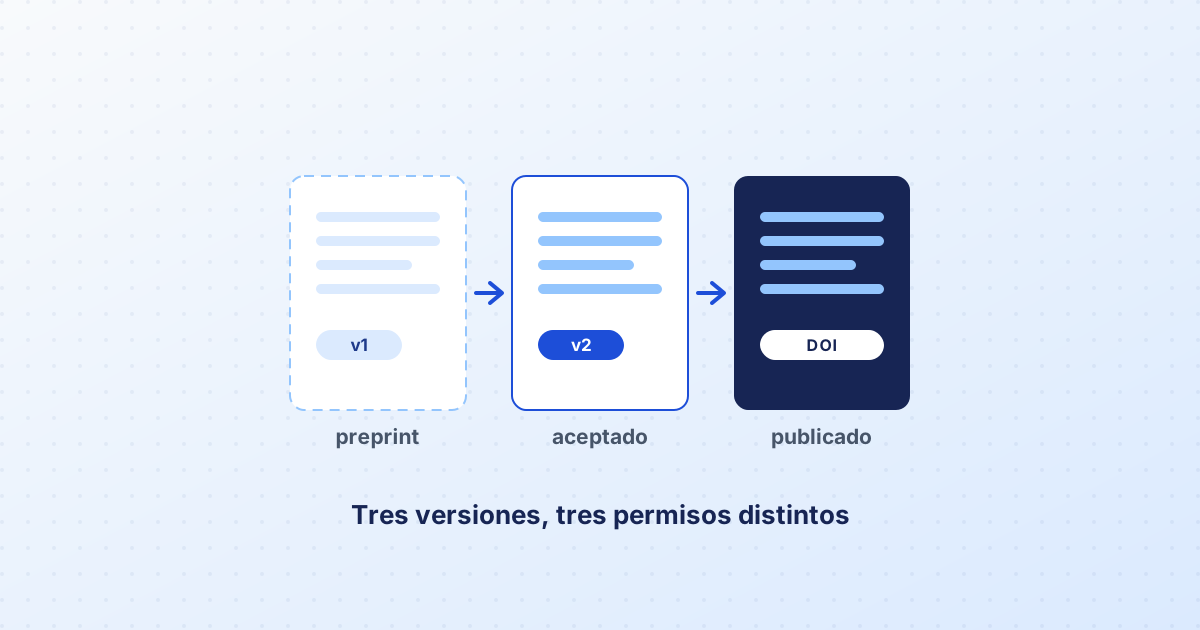
The three versions of the same article
- Preprint: the manuscript exactly as you submitted it, before peer review.
- Postprint or accepted manuscript: the text after review and acceptance, with every change the reviewers asked for, but without the journal’s typesetting.
- Version of record: the final PDF, with the layout, pagination and the journal’s logo.
These are three different files with three different permissions. Most publishing agreements allow the preprint to be deposited freely, allow the postprint after an embargo period, and reserve the version of record. But it varies a great deal: check case by case on the journal’s site or in a policy service such as Sherpa Romeo.
Why post a preprint
- A firm date. The deposit is public evidence that the result is yours and when you obtained it.
- Speed. The work circulates while review runs its course, which can take months.
- Early feedback. More than one error gets corrected before publication thanks to an attentive reader.
- Access. Anyone who cannot pay for the journal can still read you.
The precautions
- Check the journal’s policy before depositing. A few journals still treat a preprint as prior publication. They are a minority, but they exist.
- A preprint is not a reviewed article. Say so when citing or sharing one. It matters especially in public health topics, where a preliminary result can circulate as if it were settled.
- Choose a server that assigns DOIs and states its preservation policy. A preprint without a persistent identifier is hard to cite.
- Update the record once the article is published. Serious servers let you link the published version from the preprint. Doing so stops the old version from circulating on its own.
Depositing in the institutional repository
Almost every university has a repository, and almost every one holds less than it should because authors do not deposit. Three things that help:
- Save the accepted manuscript — the final Word or LaTeX file, before typesetting — at the moment of acceptance. Afterwards it is impossible to reconstruct.
- Note the publication date and the embargo, if any, so you know when you may deposit.
- Deposit with complete metadata: title, authors with ORCID, affiliations, DOI of the published article, licence.
A rule of thumb
Preprint: almost always yes. Accepted manuscript: usually yes, sometimes after an embargo. Publisher PDF: only if the licence explicitly allows it, which is exactly what happens when the article came out in open access under a Creative Commons licence.