ORCID: the identifier that follows you even if your name, country or institution changes
Your name is not an identifier: it gets written five different ways, it is shared by thousands of people and it changes over time. ORCID solves exactly that problem.
The problem is not your name, it is that a name is not enough
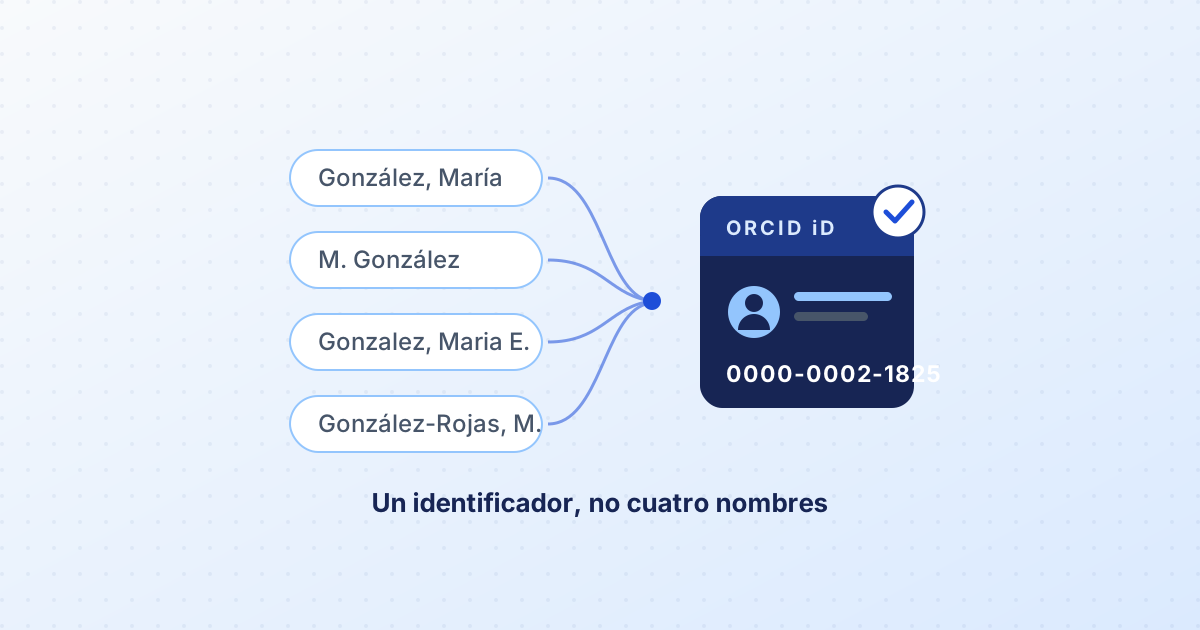
The same person can be credited as "González, María", "M. González", "María González Rojas", "Gonzalez, Maria E." and "González-Rojas, M." across five different papers. To a computer system those are five different authors. And if your surname is a common one, the problem flips: fifteen different people share the same byline and their work ends up mixed together.
On top of that, plenty of things change over the years: a surname after marriage, the transliteration of a name from another alphabet, the institution, the email address, the country. A persistent identifier exists so that none of this breaks the link between you and your work.
What an ORCID actually is
ORCID is a 16-digit code — shaped like 0000-0002-1825-0097 — attached to a public, free record that you control. It is not an academic social network or a repository: it is an identity credential. The code never changes, even when everything else does.
Registration is free for individuals, takes minutes, and the record is yours: it does not belong to your university or to the journal you published in.
How to use it properly (where almost everyone slips)
- Add it at submission time, not afterwards. When the editorial system asks for your ORCID during submission, that value travels with the article metadata all the way to the aggregators. If you add it to your profile six months later, the published article still lacks it.
- Authenticate your ORCID, do not type it. Modern systems offer a button that sends you to ORCID to sign in and returns a verified code. Typing it by hand is the main source of errors: one wrong digit and the article is credited to a different, real person.
- Make your name public in the record. If your name is set to private, no service can confirm the code is yours, and many directories choose not to display an identifier they cannot verify.
- Review your record once a year. Duplicate works, works that are not yours, outdated affiliations. Ten minutes a year prevents years of dirty data.
A mistake that is more common than it looks
While harvesting metadata from journals across the region we keep finding the same pattern: ORCIDs swapped between co-authors, the editor’s ORCID attached to an author, and the same code repeated on every byline of an article. These are manual data-entry errors, not bad faith. But the outcome is that someone’s work is counted in another person’s record.
That is why serious directories check every ORCID against the public registry before displaying it. If the name does not match, the right call is to credit no one.
What to do today
- If you do not have an ORCID, create one at orcid.org.
- Set your name and affiliations to public visibility.
- Add your ORCID to your institutional email signature and your CV.
- On your next submission, authenticate it from the form instead of copying it.
It is the half hour with the best return in a researcher’s administrative life.